
-
1 Inflamed pulp. Deep decay, a crack or an injury lets bacteria reach the pulp.
-
2 Cleaning. Through a small opening in the top, the canals are cleaned and shaped.
-
3 Sealing. The canals are filled and sealed, and a temporary filling closes the top.
-
4 Crown. Your dentist places a crown to protect the tooth.
- Inflamed pulp
- Root canal filling
- Temporary filling
- Crown
- Gum
- Bone
Why the tooth hurts, and why you can keep it
The ache comes from the pulp, the soft tissue of nerves and blood vessels inside the tooth. It sits under the white enamel and a hard layer called dentin, and it runs from the crown of the tooth down to the tip of each root. Deep decay, a crack, repeated dental work or an injury can let bacteria reach the pulp, and it becomes inflamed or infected.
You may feel it as a severe toothache when you chew, sensitivity to hot or cold that lingers, or gums near the tooth that are swollen or tender. If it hurts today, call us. We make every attempt to see you the same day.
A fully grown tooth can live without its pulp, because the tissues around the root keep nourishing it. Remove the damaged pulp, and you keep your own tooth.
What happens
Root canal treatment often takes one or two visits.
- Exam and diagnosis. We take x-rays. Dr. Brasseale reviews your health history, tests the tooth and the teeth beside it, and walks you through what he finds, your options, and the benefits and risks of each. If you decide to go ahead, treatment can start at the same visit.
- Numbing. A local anesthetic numbs the tooth. Once it’s numb, a thin sheet called a dental dam goes over the area to keep the tooth clean and dry.
- Cleaning. Dr. Brasseale makes a small opening in the top of the tooth. Under the microscope, he removes the pulp with very fine instruments and rinsing solutions, then cleans and shapes each canal.
- Filling and sealing. We fill the canals with gutta-percha, a rubber-like material, and seal them with an adhesive cement. A temporary filling closes the opening. If you need a second visit, medicine goes inside the tooth in between.
- Before you leave. We take x-rays to check the result and send a report to your dentist. You go home with written aftercare instructions, and our team offers to schedule your visit with your dentist for the permanent filling or crown.
Your dentist then removes the temporary filling and restores the tooth, usually with a crown. If not much of the tooth is left, a small post may go inside it to help hold the restoration. Dr. Brasseale or your dentist can tell you what’s planned for your tooth.
For your first visit, bring a list of every medicine you take, prescription and over-the-counter. You can fill out your paperwork ahead of time or when you arrive.
Does it hurt
Most root canals are done to stop pain, the ache of an inflamed or infected pulp. A local anesthetic keeps you thoroughly numb, and the treatment itself is usually no more uncomfortable than having a filling.
Afterward, the tooth may feel sore for a few days, especially if it hurt or was infected before treatment. Over-the-counter pain relievers usually take care of it, and Dr. Brasseale can prescribe something stronger if you need it. A review of 72 studies found that pain eased within a day of treatment and fell to minimal levels within a week.
Your tooth may feel a little different from your other teeth for a while. Follow your aftercare instructions, and call us if severe pain or pressure lasts more than a few days.
Why an endodontist
You’ll be treated by a specialist. Endodontists are dentists who complete at least two more years of training after dental school and limit their practice to endodontics: diagnosing tooth pain and treating the inside of the tooth. Narrow, curved or blocked canals and unusual root shapes are everyday work for us.
Dr. Brasseale earned his DDS with high distinction from Indiana University School of Dentistry in 2008. He then completed a one-year general practice residency at the Richard L. Roudebush Veterans Administration Medical Center in Indianapolis. After a two-year residency in endodontics at Indiana University, he received his Master of Science in Dentistry for Endodontics and his Certificate of Endodontics in 2011. He is a member of the American Association of Endodontists.
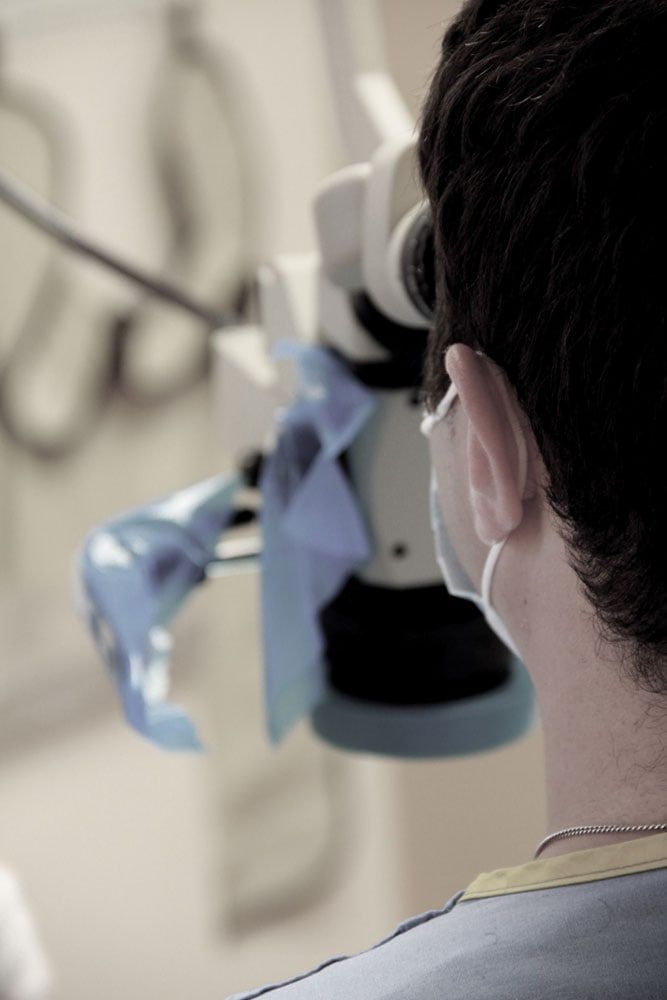
Every treatment happens under a surgical operating microscope. Its light and magnification bring small canals into view, so they are easier to find and treat. In a laboratory study of upper molars, more of the small extra canals were found and cleaned with the microscope than could be managed without magnification.
Making your saved tooth last
Until your dentist restores the tooth, avoid chewing or biting on it, and see your dentist soon for the permanent filling or crown. The crown matters. In a national study of nearly 1.5 million teeth, 97 percent were still in place eight years after root canal treatment, and most of the teeth later pulled had never been fitted with a crown.
With a good restoration and ordinary brushing, flossing and checkups, a tooth that has had a root canal can last a lifetime. If it ever starts to bother you again, it can often be saved with retreatment.
Sources
- American Association of Endodontists. What is a root canal?
- American Association of Endodontists. Root canals explained.
- American Association of Endodontists. Why see an endodontist?
- MedlinePlus, US National Library of Medicine. Root canal.
- American Dental Association, MouthHealthy. Root canals.
- Pak JG, White SN. Pain prevalence and severity before, during, and after root canal treatment, a systematic review. Journal of Endodontics, 2011.
- Salehrabi R, Rotstein I. Endodontic treatment outcomes in a large patient population in the USA, an epidemiological study. Journal of Endodontics, 2004.
- Görduysus MO, Görduysus M, Friedman S. Operating microscope improves negotiation of second mesiobuccal canals in maxillary molars. Journal of Endodontics, 2001.